
Table of Contents
ElevenLabs has added NVIDIA Nemotron 3.5 Super VL to ElevenAgents, giving businesses another open-model option for the reasoning and tool use behind conversational AI. The expanded partnership also includes plans for 15 megawatts of NVIDIA Vera Rubin compute capacity and a voice-agent deployment for Poland’s national e-Health platform.
The companies are connecting three parts of a voice-agent system: the model that decides how to respond and act, the audio models that make conversation possible, and the infrastructure that runs them. Enterprises and governments can customize agents with their own data and run them within infrastructure that meets security and data-residency requirements.
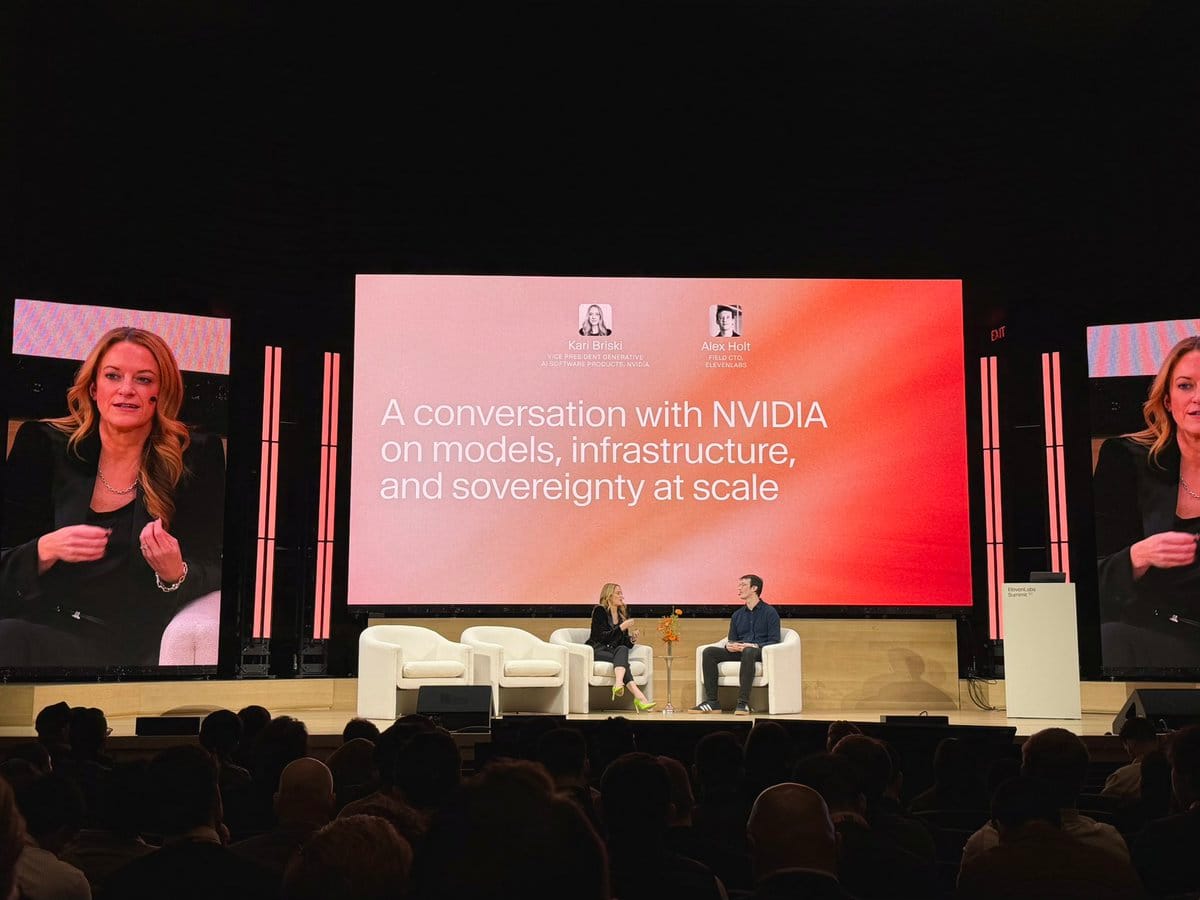
The partnership expanded at the ElevenLabs New York Summit, where ElevenLabs also previewed broader updates to its voice and chat agent platform.
Nemotron Handles the Work Behind the Conversation
Nemotron’s role in ElevenAgents goes beyond generating conversational replies. The open models are built for tasks that involve reasoning, calling tools, and carrying out multiple steps. Paired with ElevenLabs’ low-latency, multilingual audio models, they provide the decision-making layer behind a spoken interaction.
In a billing conversation, for example, producing a fluent answer is only part of the job. The agent may also need to interpret account information, perform a calculation, and use a connected tool to complete the customer’s request. That makes task completion, rather than the quality of an isolated response, a useful measure of the system’s performance.
On its benchmark of realistic customer-support tasks, ElevenLabs reports that Nemotron 3.5 Super VL achieved leading end-to-end task-completion accuracy, including strong results in financial calculations and billing analysis, at 70% lower cost than other leading open models.
For simpler requests, developers can turn reasoning off. In that configuration, Nemotron ranks among the three fastest models available in ElevenAgents, giving teams a way to prioritize response speed when a task does not require more extensive reasoning.
Businesses can also post-train Nemotron models on enterprise data and expertise, then use those customized models in ElevenAgents. Post-training adapts an already trained model to more specific requirements, such as a company’s terminology or workflows, rather than building a model from scratch.
NVIDIA said the integration gives organizations more choice in building and customizing voice agents. That choice covers both the model selected for an agent and the ability to adapt it to a particular business.
A Government Voice Agent for Healthcare Access
In Poland, ElevenLabs models and NVIDIA infrastructure power a voice agent for Centralna e-Rejestracja, the central appointment system within the national e-Health platform. EasyCall is supporting delivery of the solution.
The agent calls patients who only have landlines, reminding them about appointments and helping them reschedule. It brings an automated service to people through a channel they already use, without requiring a smartphone or an online account to receive a reminder.
ElevenLabs cites 40 million appointments a year and no-show rates of 10% to 20% as the scale of the scheduling problem. Reminder and rescheduling calls are intended to reduce missed visits and make better use of available appointments.
The deployment runs on-premises with NVIDIA Confidential Computing. Citizen data and audio remain within government infrastructure, with protection extending to data during processing. Running the system locally also reduces latency for real-time interactions.
Vera Rubin Capacity for Larger Deployments
ElevenLabs plans to add 15 MW of next-generation NVIDIA Vera Rubin capacity to its on-premises infrastructure, supplementing its existing Blackwell Ultra systems. The expansion is intended to support its largest customers, including deployments with strict security and data-residency requirements, while providing optimized compute for its research teams.
The infrastructure work extends a relationship that began in 2022, when ElevenLabs trained its first text-to-speech model on NVIDIA GPUs. Since 2024, NVIDIA has used ElevenLabs technology for voiceovers in more than 50 videos across its major events, including translations of Jensen Huang’s keynotes. NVIDIA became a strategic investor in ElevenLabs in 2025.
“As voice agents become critical infrastructure, businesses need to be able to operate securely, efficiently, reliably, and with control over their data,” ElevenLabs co-founder and CEO Mati Staniszewski said in the companies’ partnership announcement.
Extending Voice AI to Machines and Vehicles
The companies are also exploring on-device voice AI for robotics and physical AI, combining ElevenLabs’ audio models with NVIDIA edge computing platforms. Edge computing runs workloads on or near the device, rather than relying entirely on a remote data center.
Their work targets more natural spoken interaction with industrial equipment, robots, and vehicles. Potential applications include voice control of heavy machinery, hands-free communication with robots on factory floors, and spoken interaction between drivers or operators and their vehicles.